ehsan-0801/book_my_rooms
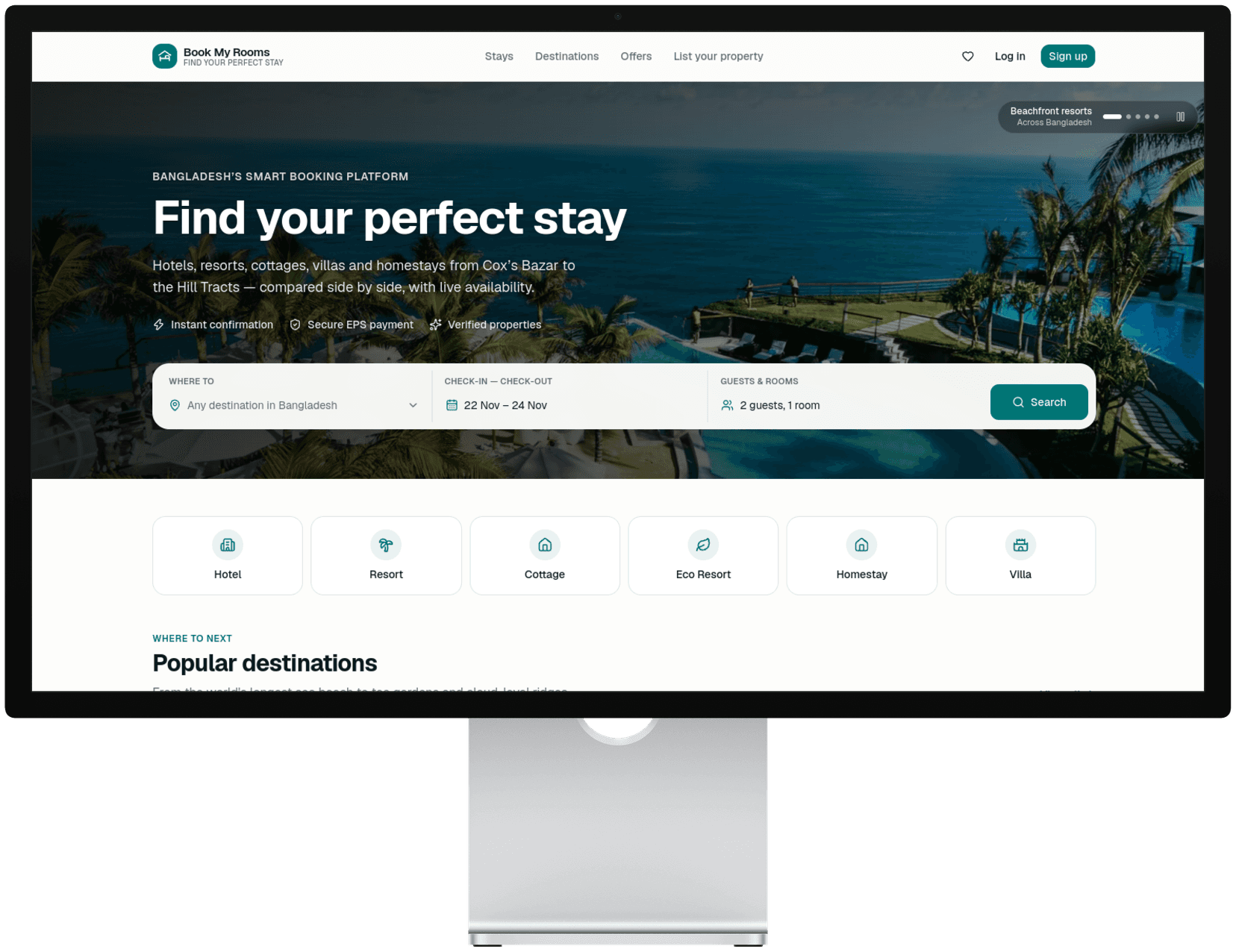
PublicBook My Rooms is a full-stack room booking and management platform that allows users to explore available rooms, check availability, and make reservations through a user-friendly interface. It streamlines the booking process while providing management capabilities to handle room listings, reservations, and booking activities efficiently.
Book My Rooms
Multi-vendor hotel, resort and travel booking marketplace for Bangladesh.
Built against the SRS in Book My Rooms.md.
Stack: Next.js 16 (App Router, Turbopack) · React 19 · TypeScript · Tailwind CSS v4 · shadcn/ui (Radix) · Prisma 7 · PostgreSQL (Neon) · Auth.js v5 · Cloudinary
Getting started
npm install
cp .env.example .env      # then fill in your own credentials
npx prisma migrate deploy # or `migrate dev` in development
npx prisma db seed        # optional demo catalogue + bookings
npm run dev               # http://localhost:3021
npm run build && npm start  # production, also on 3021
Demo accounts
All three use the password Password@123:
| Role | |
|---|---|
| Admin | admin@bookmyrooms.com.bd |
| Vendor | vendor.seapearl@bookmyrooms.com.bd |
| Customer | nusrat@example.com |
Architecture
Route groups
Role never appears in a URL. Two layout groups split the chrome:
src/app/
  (storefront)/   public marketplace — site header, footer, WhatsApp CTA
  (dashboard)/    signed-in panels   — sidebar, role badge, user menu
All three roles share the /dashboard namespace. Segments common to more
than one role (bookings, properties, reviews, settings) render
different content per role rather than being duplicated under /admin/... and
/vendor/... — which is what keeps the role out of the URL while avoiding
route collisions.
Authorisation
Three layers, because middleware alone is not an authorisation boundary:
src/middleware.ts— redirects anonymous visitors away from/dashboard/*. Runs on the edge, so it holds no Prisma or bcrypt.src/lib/auth-guards.ts—requireAdmin()/requireVendor()/requireRole()in every page's server component.src/lib/rbac.ts— the real boundary. Every server action and route handler resolves the actor here and scopes writes by ownership (assertPropertyAccess,assertRoomAccess,assertBookingAccess). A vendor's id is taken from their session, never from the submitted form, so one vendor cannot reach another's rows.
Financial and administrative mutations write an AuditLog row (SRS §66).
Media
Images upload straight from the browser to Cloudinary using a short-lived
signature minted by /api/upload/sign; the file never passes through the Next
server. The signing route picks the folder itself (book_my_rooms/{properties, rooms,avatars,banners}), so a caller cannot write outside the project folder,
and it refuses kinds the caller's role isn't allowed to upload.
Responsive strategy
Mobile-first (SRS §71).
- Dashboard tables —
src/components/dashboard/data-table.tsxtakes one column definition and renders a real<table>frommdup, and a card per row below it. Each column declares where it lands on the card (title/meta/body/footer/hide). - Search bar — stacked → 2×2 grid (
md) → single row (lg). - Search results — filter sheet on mobile, sticky rail from
lg. - Property detail — sticky bottom bar on mobile, booking sidebar from
lg.
Deletion is the only action behind a confirmation modal
(delete-dialog.tsx) — everything else is reversible and submits directly.
Cascading deletes additionally require typing DELETE.
Feedback: toasts, progress and skeletons
Every mutation returns an ActionResult (src/lib/actions/result.ts) rather
than throwing. A thrown error in a server action surfaces as an error boundary,
which loses the message and destroys the page the user was working on;
returning a result lets the UI toast it and keep the form intact.
success— it workedwarning— a refusal the user can fix ("cancel the 3 active bookings first")error— validation or an unexpected failure
ActionForm / ActionButton (action-form.tsx) wrap every mutation and
announce the result. They submit imperatively rather than through
useActionState: many of these forms delete the row they live in, so the
component unmounts the moment the action revalidates and an effect watching the
returned state would never fire. Awaiting the action inside the submit handler
keeps the continuation alive past unmount, so the toast always lands.
Toasts sit bottom-right on desktop and top-centre on mobile
(app-toaster.tsx) — a bottom toast on a phone would land under the sticky
booking bar and the WhatsApp button.
A progress bar under the navbar (navigation-progress.tsx) covers both route
changes and saves. App Router exposes no router events, so navigation is
detected from both ends: a delegated click on any internal link starts it, and
the pathname changing finishes it. Server actions drive the same store.
Every dashboard route has a loading.tsx built from the shared skeletons in
skeletons.tsx, shaped like the page it replaces — same table-on-desktop /
cards-on-mobile split as DataTable, so nothing jumps when data lands.
Loading boundaries only appear on client navigation when the route was prefetched, and Next disables prefetching in development. Verify skeletons against
npm run build && npm start, notnpm run dev.
Routes
Storefront
/ · /properties · /properties/[destination]/[slug] · /destinations ·
/destinations/[slug] · /offers · /checkout · /booking/[reference] ·
/login · /register · /vendor
Dashboard
| Segment | Admin | Vendor | Customer |
|---|---|---|---|
/dashboard | ✅ | ✅ | ✅ |
bookings, bookings/[id] | ✅ | ✅ | ✅ |
reviews (+ new, [id]/edit) | ✅ | ✅ | ✅ |
settings | ✅ | ✅ | ✅ |
properties (+ new, [id]/edit) | ✅ | ✅ | — |
rooms (+ new, [id]/edit) | ✅ | ✅ | — |
availability | ✅ | ✅ | — |
offers, earnings | — | ✅ | — |
vendors, vendors/[id] | ✅ | — | — |
customers, customers/[id] | ✅ | — | — |
payments, commissions | ✅ | — | — |
destinations, amenities, coupons | ✅ | — | — |
banners, pages | ✅ | — | — |
refunds, payouts | ✅ | — | — |
areas, property-types | ✅ | — | — |
wishlist | — | — | ✅ |
Environment
.env (development) and .env.prod (production) are both gitignored;
.env.example documents the shape.
Before deploying, generate a fresh AUTH_SECRET with npx auth secret — the
placeholder in .env.prod must not be reused, or session cookies can be forged.
prismais pinned to7.10.0. Thelatestdist-tag on npm currently points at an8.0.0-rc, so don't runnpm update prismawithout checking.
Connection strings use sslmode=verify-full, not require. Today pg treats
them identically, but from pg v9 require adopts libpq semantics — encrypt
without verifying the server certificate — so leaving it would silently weaken
the production connection on a routine dependency upgrade.
Prisma 7 keeps the connection URL in prisma.config.ts
rather than the schema, and the client connects through @prisma/adapter-pg.
Migrations use the unpooled Neon URL — pgbouncer can't hold the advisory
locks Prisma Migrate needs.
Credits
Destination photography from Wikimedia Commons under CC BY / CC BY-SA;
attribution travels with each record in src/lib/destinations.ts and renders on
every destination page, as those licences require. Property and room
photography from Unsplash.